
01
Scope your actual products
Select multiple product families. Battery portfolios spanning full passports and QR-only requirements receive separate ratings.
Free readiness score + industry-specific implementation playbook
Why act now?
The new Toy Safety Regulation (EU) 2025/2509 is in force since 1 January 2026. From 1 August 2030, every toy needs a Digital Product Passport before it is placed on the market, its identifiers registered in the EU registry, and customs will check them before imported toys are released. The passport replaces the EU declaration of conformity.
until every toy placed on the EU market needs a Digital Product Passport
1 August 2030
Digital Product Passport for every toy
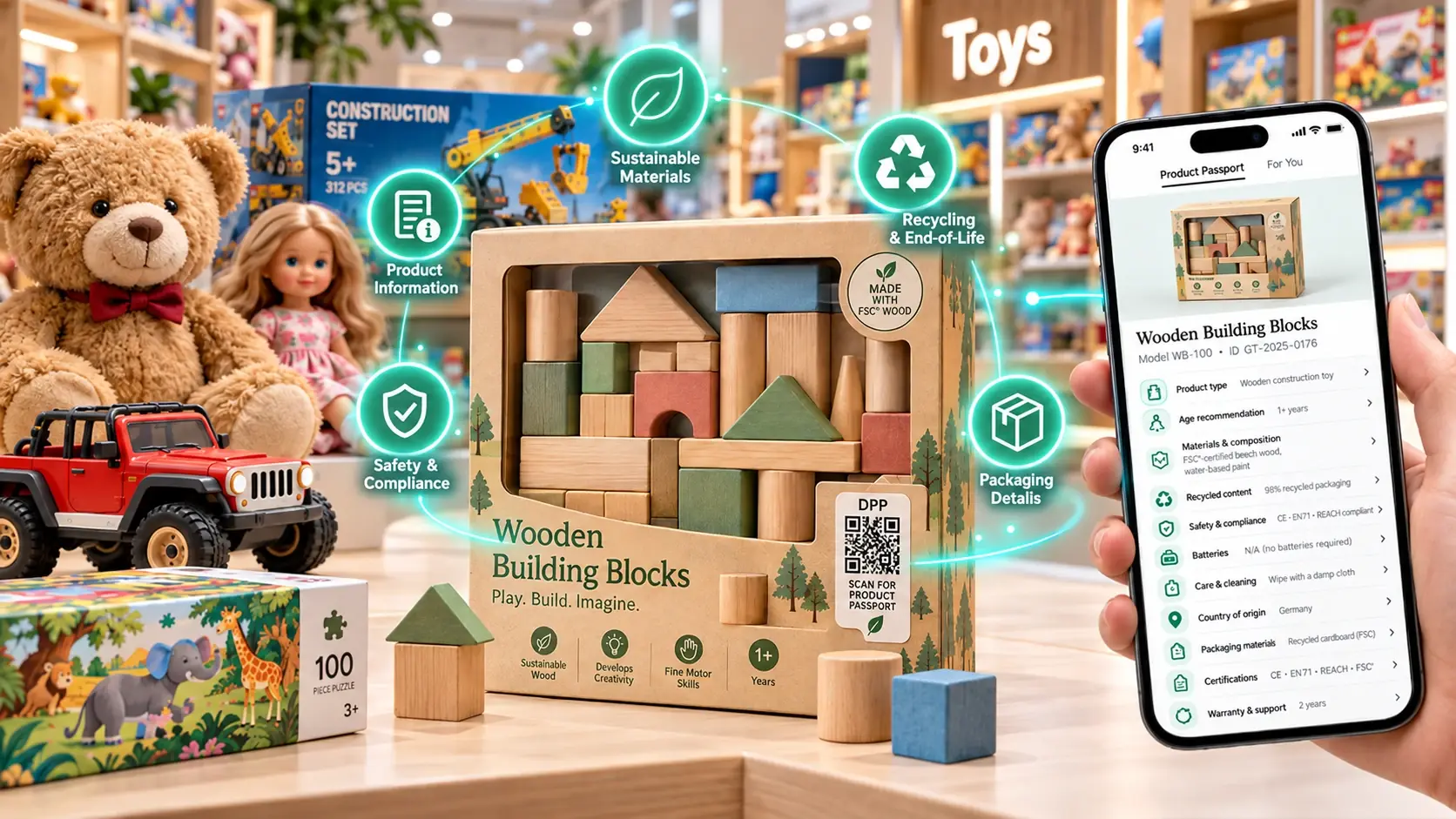
Unlike most product groups, toys do not wait for an ESPR delegated act: the Toy Safety Regulation (EU) 2025/2509 sets out the passport itself, in its Articles 19 to 24 and Annex VI. It is created per toy model before the toy is placed on the market, follows the ESPR standards for identifiers and data carriers, uses the EU registry, stays available for 10 years with a back-up copy, and replaces the EU declaration of conformity.
Annex VI of the regulation lists what the passport must contain:
Identity and Responsible Operators
Unique product identifier, a colour image of the toy, the commodity code, and the manufacturer and responsible operators with their unique operator identifiers
Conformity
The EU laws the toy complies with, the harmonised standards or common specifications applied, the notified body and certificate where applicable, and the CE marking
Allergenic Fragrances
The allergenic fragrances the toy contains above the labelling threshold
Safety Information
Optionally, warnings, safety information and instructions for use, alongside those that must stay on the toy
Complaints and Back-up
The complaint channel, a link to the Safety Gate portal and the DPP service provider holding the back-up copy
All structured, machine-readable, and ready for parents, retailers, market surveillance and customs.

The new toy rules change how conformity is declared, how toys are imported and which chemicals are allowed. We follow every step so you don’t have to.
End-to-end support to simplify your DPP rollout.
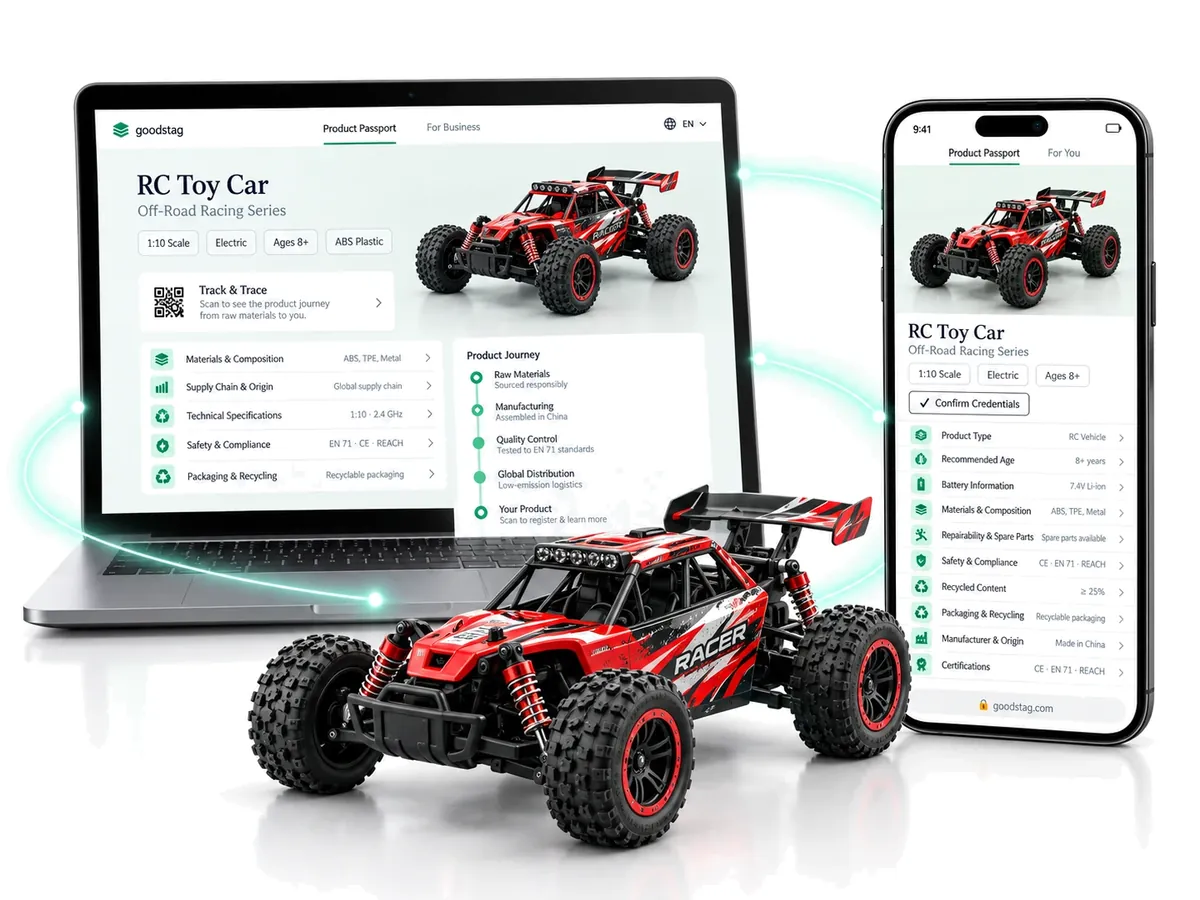
A toy passport depends on data from factories, test laboratories, notified bodies and importers, model by model and season by season.
Test reports and certificates spread across laboratories and suppliers
Chemical and fragrance data that is hard to collect from factories
Hundreds of new models and variants every season
Imports that must pass the registry check at customs
Unclear internal ownership

Your passports stay accurate through new models, test results, reformulations and evolving regulations, for the 10 years they must stay available.

Handles large toy ranges with many models, variants and seasonal launches across factories and markets.

Your data model follows Annex VI of the Toy Safety Regulation and the technical rules as the Commission adopts them.

Proven track record in high-stakes, high-volume environments.
Implementation workflow
Collect your data, validate it, link a label, publish the passport and keep it up to date.
Step 1
Bring in ERP, PLM, PIM, quality and lab data through existing APIs, files and supplier forms.
Step 2
Map fields to versioned product-family schemas. Show validation, review, approval and how missing evidence is handled.
Step 3
Factory and logistics workflows associate a pre-printed identifier with a product, batch or item through a scan or system integration.
Step 4
Show which information is public and which evidence requires authorised access.
Step 5
Explain updates, version history, export and independent backup using the verified product and commercial terms.
Data carriers and standards, GS1 Digital Link conformant, API-first, multiple identity levels from model to item, and role-based data access.
Architecture aligned with the passport lifecycle, controlled access and GDPR-compliant processing. Successful EU Registry TEST registrations; production automated API integration in preparation.
Request a live demo
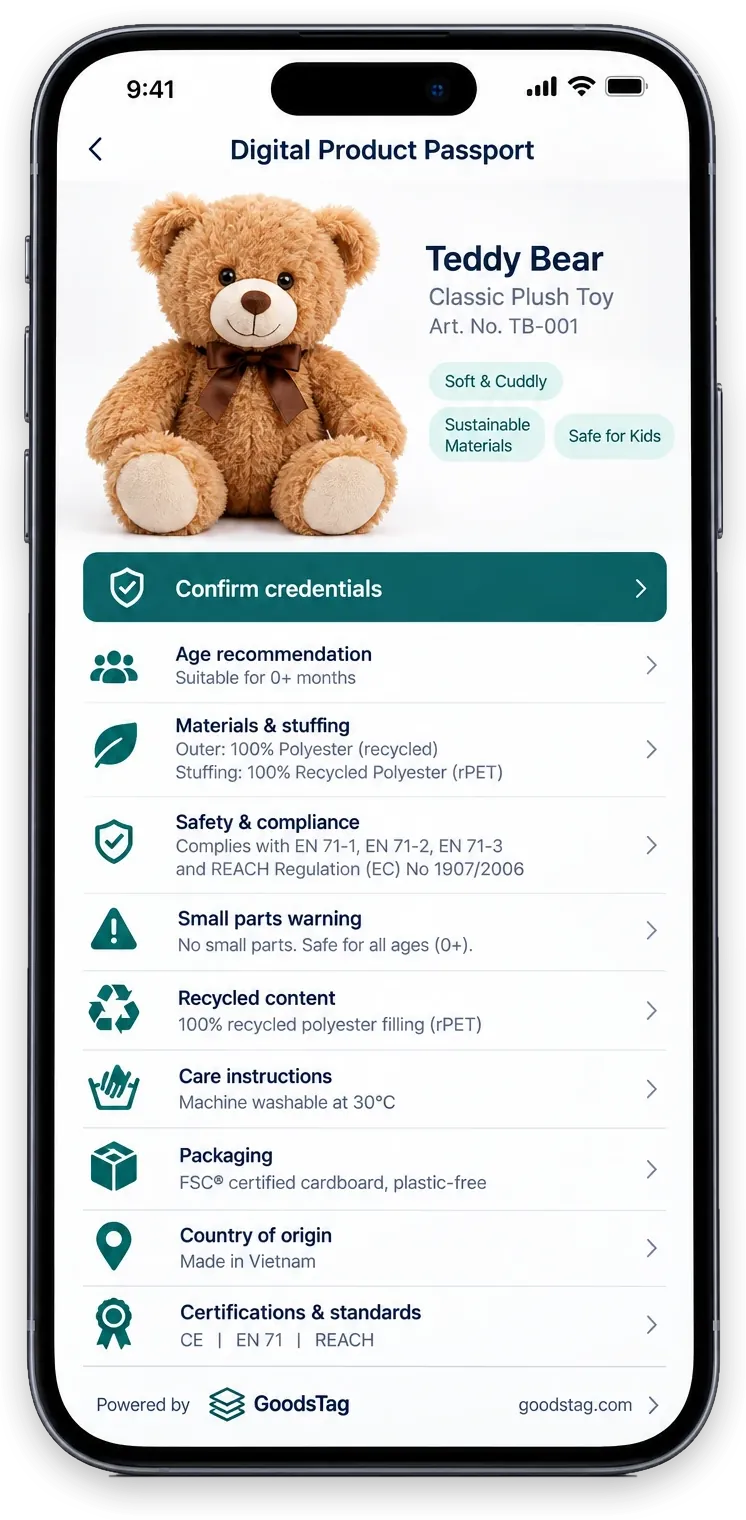
Parents won’t read a technical file. They’ll scan a QR code on the toy, the label or the box, before they buy.
Here’s an example of what they (and retailers and authorities) could see on the other side. Sample data only.
Want to see it with your own products? [Talk to us]
The toy passport is already law: the Toy Safety Regulation was published in December 2025 and its passport becomes mandatory on 1 August 2030. The technical details will follow in a Commission delegated act.
Here are the key dates you need to know about (as of October 2026):






Tell us about your toys DPP requirements. We will help you identify the right approach.
Your message has been submitted.
We will get back to you within 24-48 hours.
A Digital Product Passport is a structured, machine-readable data set that stores verified product information about a toy. Under the Toy Safety Regulation (EU) 2025/2509, it is created per toy model before the toy is placed on the market and holds the toy's identity, the responsible operators, the EU laws and standards it complies with, the CE marking and the allergenic fragrances it contains, reachable through a data carrier on the toy or its label.
From 1 August 2030, when the Toy Safety Regulation applies. It entered into force on 1 January 2026. The Commission will set the passport's technical requirements by delegated act, which must apply at least 18 months after it enters into force, and will publish guidelines for SMEs by 1 August 2029.
Yes. The regulation has no separate declaration of conformity for toys: the passport takes its place. Where a toy also falls under other EU law that requires a declaration of conformity, for example on radio equipment, cybersecurity or artificial intelligence, the passport can carry that information too and then counts as that declaration.
The CE marking, the type, batch or serial number, the warnings, the instructions and safety information, and the manufacturer's name and postal and electronic address. The passport can hold the address only where putting it on the toy or the packaging is not feasible. Warnings must be clearly visible before purchase, also online, with a minimum text and pictogram size.
On the toy or an affixed label, or, where that is not possible, on the packaging or accompanying documents. It must be clearly visible to the consumer before purchase, including in online sales, and online marketplaces must let sellers show it. Operators must give distributors and marketplaces a digital copy of the data carrier on request within 5 working days.
Before placing a toy on the market, the operator uploads its unique product identifier and unique operator identifier to the EU registry set up under the ESPR and receives a unique registration identifier. For imports, the declarant gives customs that identifier, and customs check it against the registry before releasing the toy for free circulation, automatically through the EU single window.
From 1 August 2030, toys may not contain substances classified as carcinogenic, mutagenic or toxic for reproduction, endocrine disruptors, substances toxic to specific organs, respiratory sensitisers or certain skin sensitisers, subject to limited derogations. Intentionally added PFAS and listed bisphenols are banned, and allergenic fragrances above 10 mg/kg must be named on the toy and in the passport.
For 10 years, also if the operator becomes insolvent, and a back-up copy must be held by a DPP service provider. Access must be free of charge, and consumers may not be asked to register or give a password. GoodsTag stores passports and their back-up so they stay available over that period.
GoodsTag features an API-first architecture that integrates with your existing enterprise systems, including ERP, PLM, PIM, test laboratory and supplier databases such as SAP S/4HANA. Data synchronization is event-driven and supports global GS1 standards like EPCIS 2.0 and GS1 Digital Link for real-time traceability.
The technical delegated act for the toy passport has not been adopted, so no platform can claim full compliance with it today. GoodsTag builds on what the regulation already sets: a passport per model with the Annex VI content, a data carrier linked to a persistent unique identifier, open and interoperable formats without vendor lock-in, free access without registration, and a back-up copy. Its data models are configurable, so the technical rules can be mapped as soon as they are defined.

Build your brand on top of compliance.
The passport will make the safety, materials and origin of every toy visible to parents before they buy. The brands that get there first will use it to do something more: prove safety and quality, earn trust, and turn product data into a competitive edge.
Assess the entire journey: supplier data, ERP/MES integration, QR labelling, factory activation, publication and lifecycle operation.
Contact details are requested before personalised results are shown.
Select multiple product families. Battery portfolios spanning full passports and QR-only requirements receive separate ratings.
Identify missing supplier evidence, IT integration, QR production pairing, registry and lifecycle risks.
Sector checklist with tasks, owners, expected evidence and CSV/PDF export.
The complete sector-level baseline checklist. This resource is generic and available without an assessment. Complete the questionnaire for product-specific priority actions and scores.
Self-reported responses; not a certification or legal compliance verdict. Factory go-live remains subject to actual production acceptance tests.
Adopted · DPP applies from 1 August 2030
Suggested owners and evidence are planning aids. Applicable laws and deadlines require confirmation for the product category, operator role and current regulatory version.
GoodsTag can independently review supplier data workflows, identifiers, integration and production activation, including passports built using another platform.