
01
Scope your actual products
Select multiple product families. Battery portfolios spanning full passports and QR-only requirements receive separate ratings.
Free readiness score + industry-specific implementation playbook
Why act now?
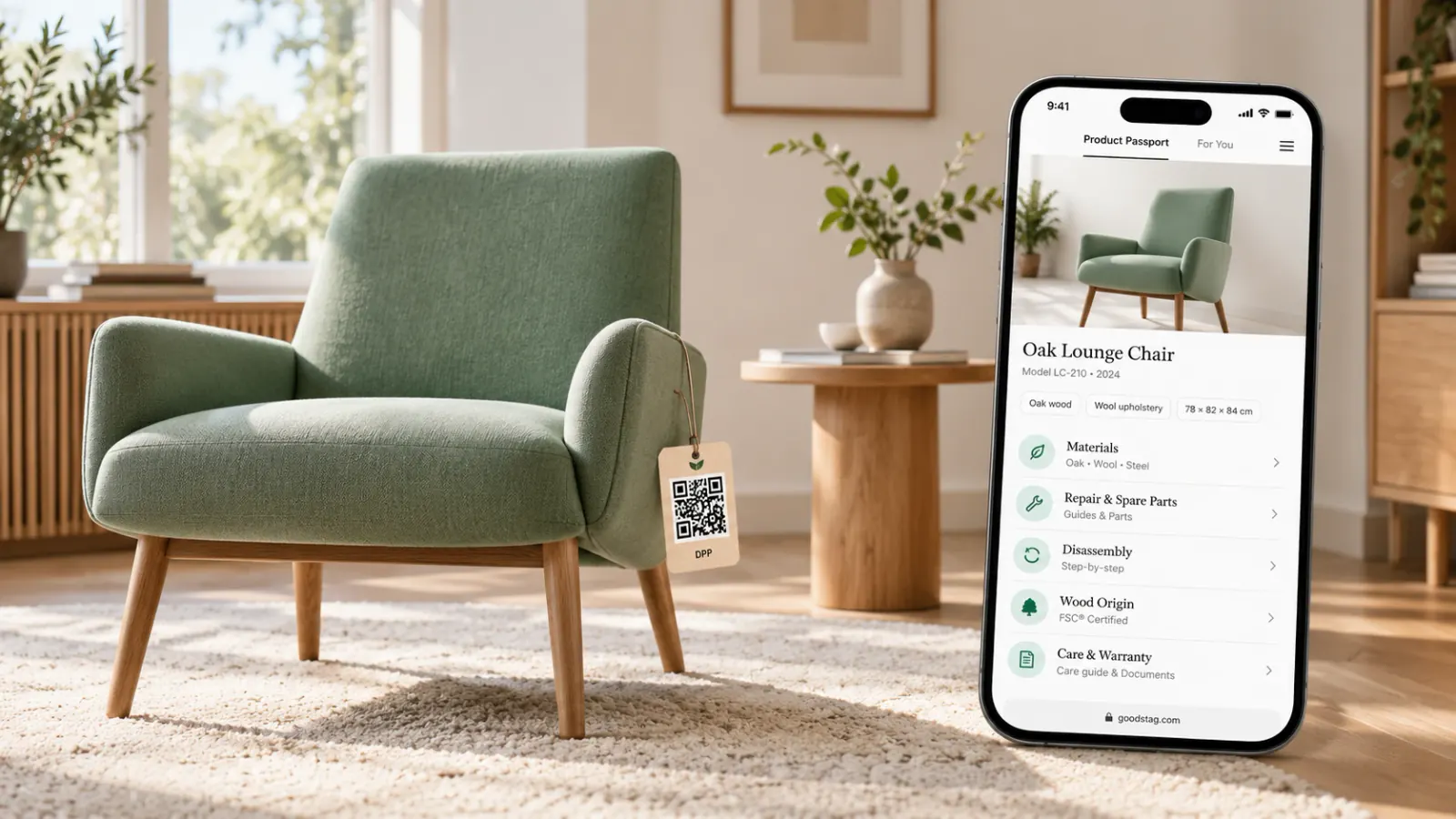
The EU plans to adopt furniture-specific rules in 2028, with compliance requirements to follow later. Material traceability, wood origin, repairability and supplier documentation are already becoming increasingly important. Building this foundation now helps avoid costly last-minute changes across your product portfolio.
2028
EU furniture DPP rules expected
Furniture is one of the product groups the EU wants to tackle first under the Ecodesign for Sustainable Products Regulation (ESPR). The regulation, already in force, names furniture, including mattresses, as a priority. No furniture-specific requirements have been adopted yet: the European Commission’s working plan 2025–2030 indicates a delegated act for furniture in 2028 and a separate one for mattresses in 2029, and a preparatory study is under way.
The delegated act will define the exact data set. Based on the aspects the preparatory study examines and the information the ESPR provides for, a furniture passport may draw on:
Identity
Unique product identifier, product model and batch, dimensions and weight, responsible economic operators
Materials and Composition
Materials used, such as wood, textiles, foams and metals, substances of concern and recycled content
Durability and Repair
Durability information, repair instructions, available spare parts and how to get them
Disassembly and End of Life
Disassembly instructions, interchangeable and upgradeable components, recycling and disposal information
Origin and Traceability
Origin of materials, certificates and the documentation that wooden furniture already needs under the EU Deforestation Regulation
All structured, machine-readable, and ready for customers, repairers, recyclers and authorities.

The requirements are still being prepared. We follow every step so you don’t have to.
End-to-end support to simplify your DPP rollout.
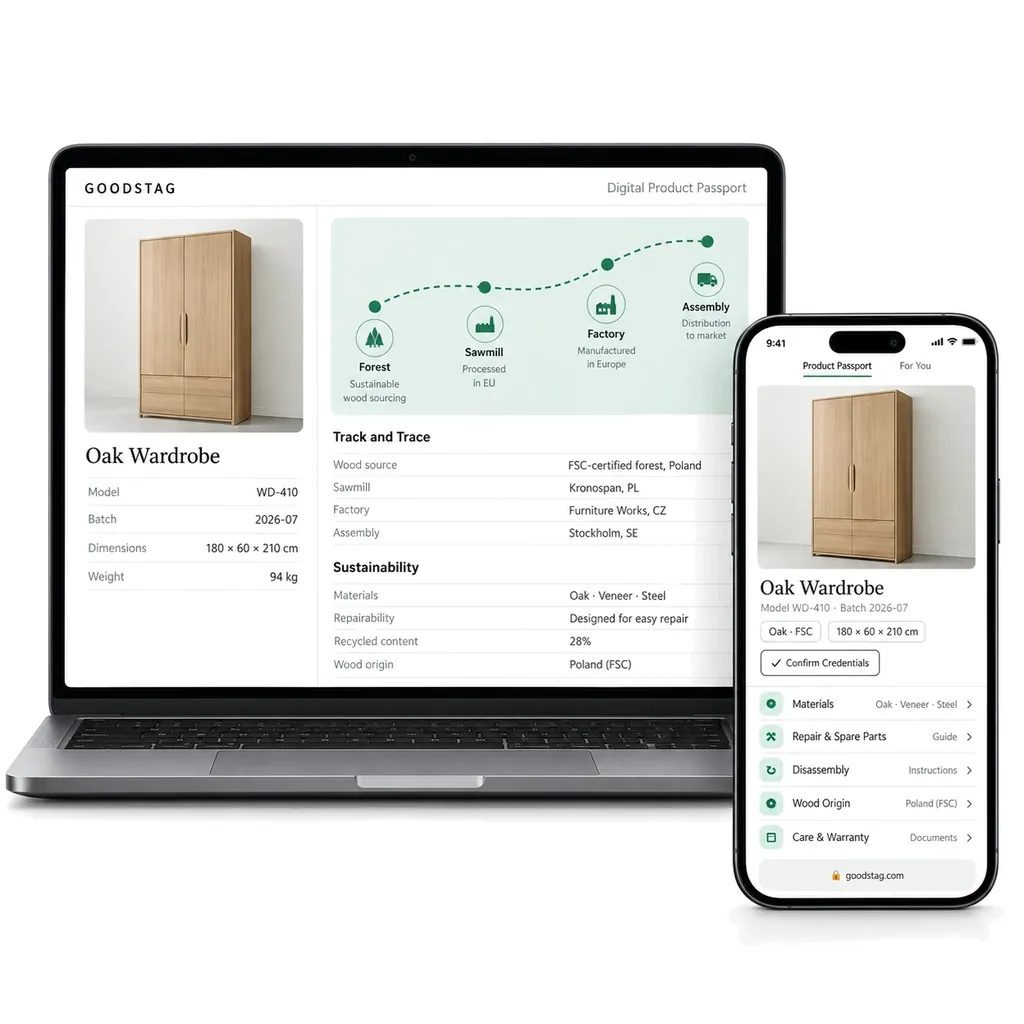
From forest to living room, a furniture passport depends on data spread across many suppliers and materials.
Material data spread across many suppliers
Wood origin data that is hard to collect
Inconsistent certificates, formats and documentation
Repair and spare part information kept in separate systems
Unclear internal ownership

Your DPP stays accurate through supplier changes, new collections, and evolving regulations.

Handles large ranges of models, variants, fabrics and finishes across suppliers.

Your data model follows the EU requirements as they are finalised, and your data stays structured for audit-ready reporting.

Proven track record in high-stakes, high-volume environments.
Implementation workflow
Collect your data, validate it, link a label, publish the passport and keep it up to date.
Step 1
Bring in ERP, PLM, PIM, quality and lab data through existing APIs, files and supplier forms.
Step 2
Map fields to versioned product-family schemas. Show validation, review, approval and how missing evidence is handled.
Step 3
Factory and logistics workflows associate a pre-printed identifier with a product, batch or item through a scan or system integration.
Step 4
Show which information is public and which evidence requires authorised access.
Step 5
Explain updates, version history, export and independent backup using the verified product and commercial terms.
Data carriers and standards, GS1 Digital Link conformant, API-first, multiple identity levels from model to item, and role-based data access.
Architecture aligned with the passport lifecycle, controlled access and GDPR-compliant processing. Successful EU Registry TEST registrations; production automated API integration in preparation.
Request a live demo
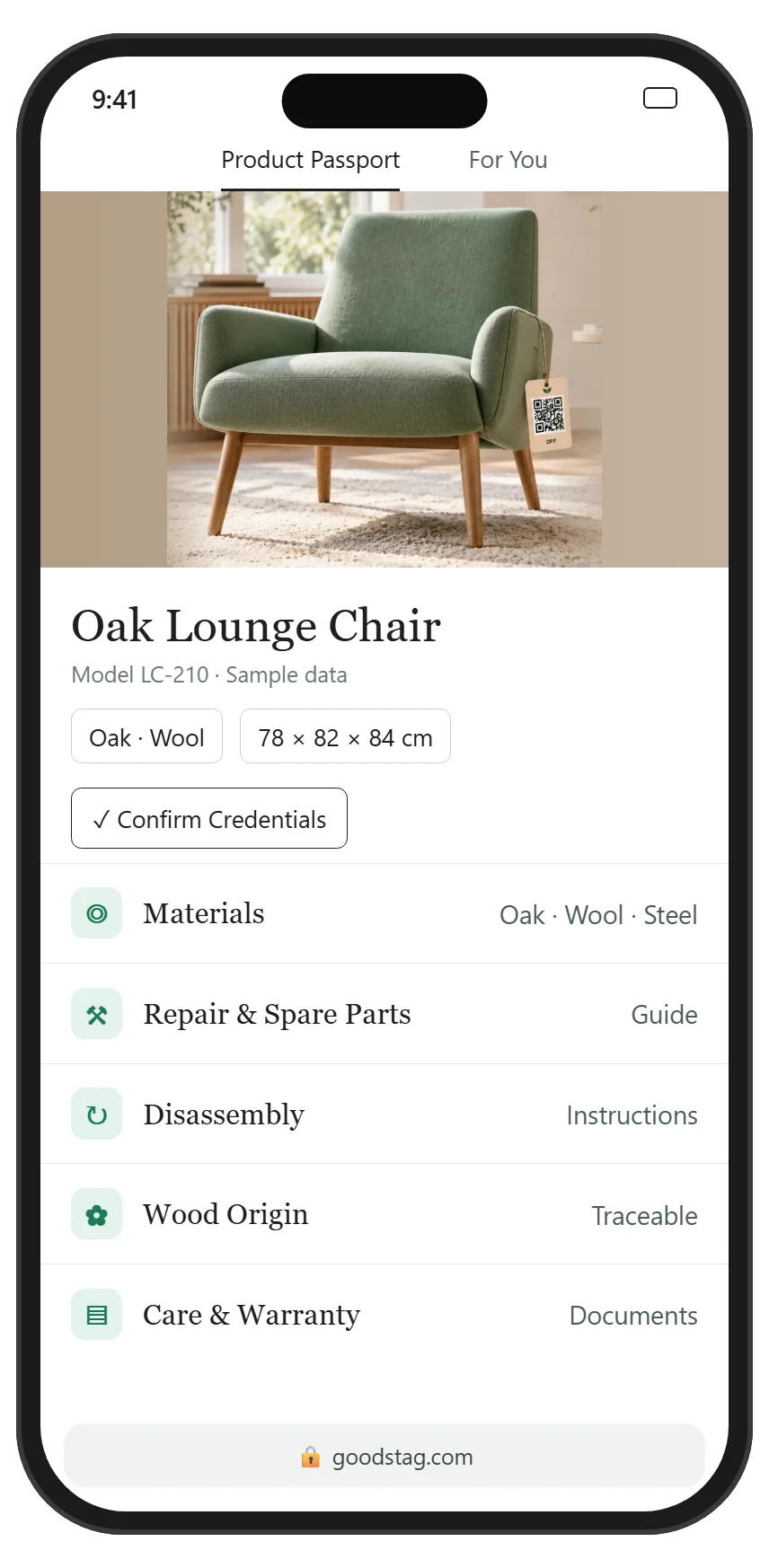
Your customers won’t read a product file. They’ll scan a QR code on the label or the packaging.
Here’s an example of what they (and authorities) could see on the other side. Sample data only.
Want to see it with your own products? [Talk to us]
Under the EU’s Ecodesign for Sustainable Products Regulation (ESPR), Digital Product Passports for furniture are on their way. No furniture act has been proposed yet, but the preparatory work has started, and related rules already apply.
Here are the key dates you need to know about (indicative, as of October 2026):






Tell us about your furniture DPP requirements. We will help you identify the right approach.
Your message has been submitted.
We will get back to you within 24-48 hours.
A Digital Product Passport is a structured, machine-readable data set that stores verified product information across a piece of furniture's lifecycle. For furniture, it is how manufacturers and importers will meet the passport requirements of the EU Ecodesign for Sustainable Products Regulation (ESPR): the regulation is already in force, and a delegated act for furniture will set the exact data and the date from which the passport is mandatory.
Not yet. As of October 2026, no delegated act for furniture has been proposed. The ESPR, Regulation (EU) 2024/1781, names furniture, including mattresses, as a priority, and the European Commission's working plan 2025–2030 indicates adoption of a delegated act for furniture in 2028 and a separate one for mattresses in 2029. A preparatory study is under way.
The delegated act will set the exact product scope, with mattresses covered by a separate act. ESPR requirements apply to the economic operators placing covered products on the EU market, such as manufacturers and importers, and the passport will have to be available for products placed on the market once the requirements apply.
The exact data set will be defined in the delegated act. The preparatory study examines aspects such as durability, reparability, disassembly, interchangeable components and upgradeability, and the ESPR allows information requirements on, for example, materials, substances of concern, recycled content and repair. Expect a mix of model-level data and production data such as batch information.
They are separate instruments. The EU Deforestation Regulation, Regulation (EU) 2023/1115, covers wooden furniture and applies from 30 December 2026, from 30 June 2027 for micro and small enterprises. It requires due diligence on the origin of the wood. A passport can carry origin information along the value chain, so collecting that data once and structuring it well serves both.
GoodsTag assigns a unique digital identity to each model, batch or item. This identity is connected to the physical product via QR codes, NFC or RFID tags on the product label or packaging. When scanned, the identifier routes the user to the product's digital twin, which hosts the verified DPP data set.
The delegated act for furniture has not been proposed yet, so no platform can claim full compliance with it today. GoodsTag builds on the principles the ESPR already sets for passports: a unique product identifier, a data carrier on the product, open and interoperable formats, and access rights for customers, repairers, recyclers and authorities. The platform is based on GS1 Digital Link. Its data models are configurable, so the furniture data set can be mapped as soon as the delegated act defines it.
GoodsTag features an API-first architecture that integrates with your existing enterprise systems, including ERP, PLM, PIM and supplier databases such as SAP S/4HANA. Data synchronization is event-driven and supports global GS1 standards like EPCIS 2.0 and GS1 Digital Link for real-time traceability.
Yes. The GoodsTag infrastructure is cloud-native and built on a microservices architecture designed for horizontal scaling. It handles large ranges of models and variants, from fabrics to finishes, across several suppliers and factories, without compromising speed.
No. GoodsTag has a modular design, so you can start at any point. Begin with digital twins at model or batch level and expand to item-level identification as operational readiness grows and the delegated act requires it. With an API-first architecture and data mapping templates, the platform can be deployed quickly alongside your existing systems.

Build your brand on top of compliance.
The DPP will make the durability, repair and material story of furniture visible to every customer. The brands that get there first will use it to do something more: prove quality and longevity, earn trust, and turn supply chain data into a competitive edge.
Assess the entire journey: supplier data, ERP/MES integration, QR labelling, factory activation, publication and lifecycle operation.
Contact details are requested before personalised results are shown.
Select multiple product families. Battery portfolios spanning full passports and QR-only requirements receive separate ratings.
Identify missing supplier evidence, IT integration, QR production pairing, registry and lifecycle risks.
Sector checklist with tasks, owners, expected evidence and CSV/PDF export.
The complete sector-level baseline checklist. This resource is generic and available without an assessment. Complete the questionnaire for product-specific priority actions and scores.
Self-reported responses; not a certification or legal compliance verdict. Factory go-live remains subject to actual production acceptance tests.
Furniture delegated act planned for 2028; mattresses separately for 2029
Suggested owners and evidence are planning aids. Applicable laws and deadlines require confirmation for the product category, operator role and current regulatory version.
GoodsTag can independently review supplier data workflows, identifiers, integration and production activation, including passports built using another platform.