
01
Scope your actual products
Select multiple product families. Battery portfolios spanning full passports and QR-only requirements receive separate ratings.

Free readiness score + industry-specific implementation playbook
Platform setup and project-specific implementation are quoted separately.
Starter subscription with 5,000 new DPPs a year included.
Long-term availability for every newly created passport.
Passport signing, authenticity protection and version history in every DPP plan.
Passport continuity beyond the primary hosting infrastructure, in every DPP plan.
Why act now?
The EU is targeting 2026 for adopting its iron and steel ecodesign requirements, with compliance obligations to follow. Connecting emissions, material composition, recycled content and traceability data across mills and suppliers is a major undertaking. Companies that structure this information early will be better prepared for both future DPP requirements and existing reporting demands.
2026
EU steel rules planned for adoption
Steel is everywhere: in buildings, cars, machines and packaging. That is why iron and steel are among the first intermediate products the EU is addressing under the Ecodesign for Sustainable Products Regulation (ESPR). The regulation is already in force. The European Commission is now preparing a delegated act for iron and steel products that will define low-carbon steel, set ecodesign requirements and improve access to sustainability information along the value chain.
The delegated act will define the exact data set. Based on what the European Commission has outlined so far, a steel passport may draw on:
Identity
Unique product identifier, product type and classification, steel grade, dimensions, batch or heat number, responsible economic operators
Material and Composition
Technical and material data, chemical composition, substances that may hinder recycling
Carbon Footprint
Greenhouse gas emissions from production, the basis on which the EU will define low-carbon steel
Recycled Content and Circularity
Share of recycled content and scrap, information that supports recycling at end of life
Compliance and Traceability
Documentation relevant to compliance and traceability, such as inspection certificates and origin information
All structured, machine-readable, and ready for customers, recyclers and authorities further down the value chain.
The requirements are still being drafted. We follow every step so you don't have to.
End-to-end support to simplify your DPP rollout.
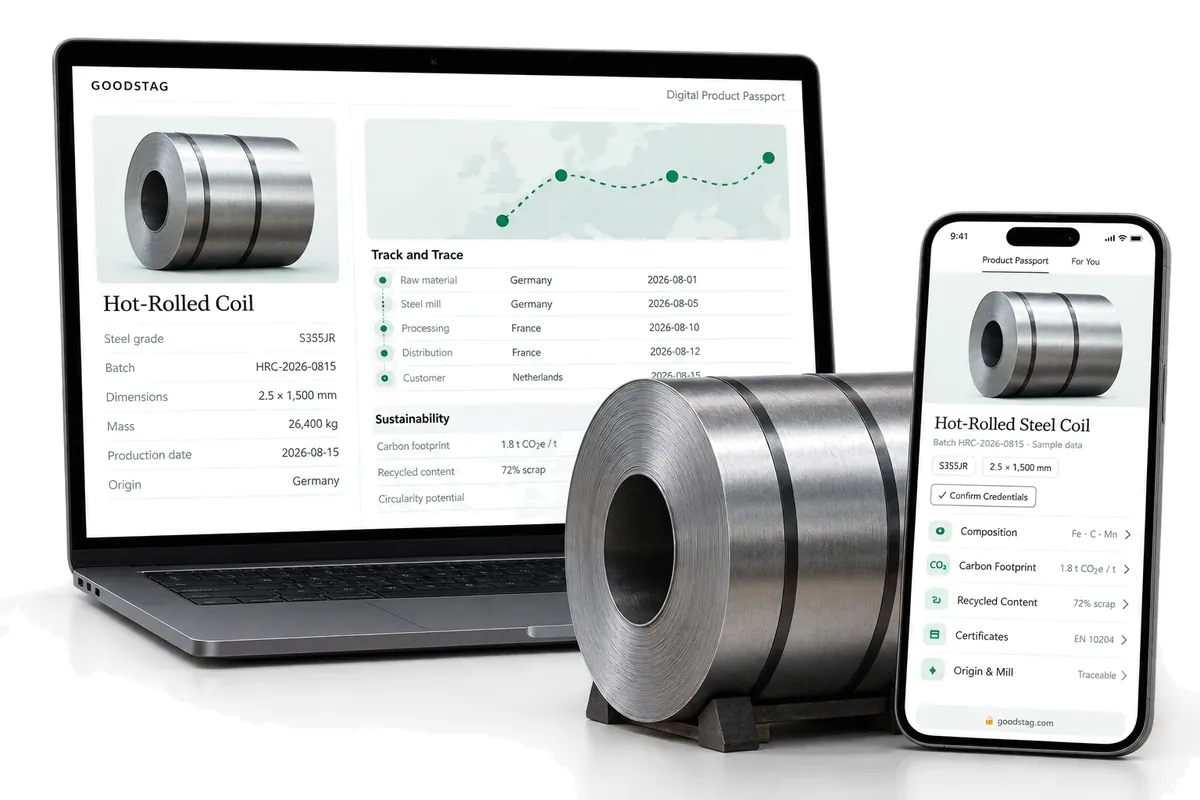
From the melt shop to the customer, a steel passport depends on data spread across the whole value chain.
Emissions data spread across plants and systems
Scrap and recycled content that is hard to trace
Inconsistent certificates, formats and documentation
Product data that changes with every heat and batch
Unclear internal ownership

Your DPP stays accurate through supplier changes, new grades, and evolving regulations.

Handles high volumes of coils, plates, bars and batches across sites and suppliers.

Your data model follows the EU requirements as they are finalised, and your data stays structured for audit-ready reporting.

Proven track record in high-stakes, high-volume environments.
Practical answers
Short answers to key questions about passports for iron and steel products, each with an in-depth article.
Use the Iron & Steel DPP buying guide for vendor shortlists while the delegated act is pending, and the implementation guide for data, identity and continuity work you can do now. Both are English editorial GoodsTag resources with disclosed commercial interest.
Not yet fixed. The ESPR delegated act for iron and steel is in preparation, indicatively for 2026. Obligations normally start at least 18 months after it enters into force.
The delegated act will set the level: model, batch or item. Pre-printed labels let you print identifiers first and link heat and batch data later in production.
The ESPR requires a backup copy held by a DPP service provider. Every GoodsTag DPP plan includes an independent third-party backup that keeps passports retrievable and portable.
Implementation workflow
Collect your data, validate it, link a label, publish the passport and keep it up to date.
Step 1
Bring in ERP, PLM, PIM, quality and lab data through existing APIs, files and supplier forms.
Step 2
Map fields to versioned product-family schemas. Show validation, review, approval and how missing evidence is handled.
Step 3
Factory and logistics workflows associate a pre-printed identifier with a product, batch or item through a scan or system integration.
Step 4
Show which information is public and which evidence requires authorised access.
Step 5
Explain updates, version history, export and independent backup using the verified product and commercial terms.
Data carriers and standards, GS1 Digital Link conformant, API-first, multiple identity levels from model to item, and role-based data access.
Architecture aligned with the passport lifecycle, controlled access and GDPR-compliant processing. Successful EU Registry TEST registrations; production automated API integration in preparation.
Request a live demo
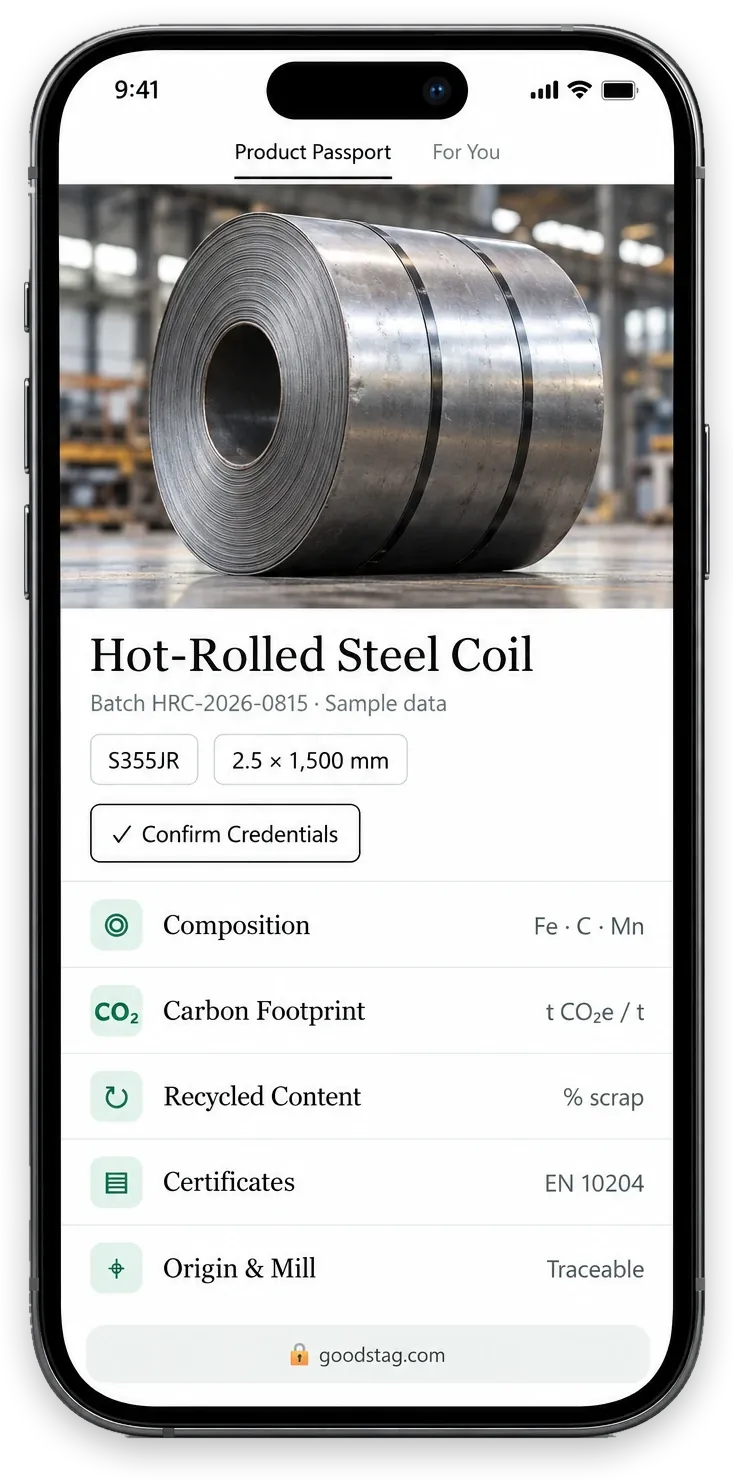
Your customers and recyclers won't dig through a mill certificate. They'll scan a QR code on the coil or its label.
Here's an example of what they (and authorities) could see on the other side. Sample data only.
Want to see it with your own products? [Talk to us]
Under the EU's Ecodesign for Sustainable Products Regulation (ESPR), Digital Product Passports for iron and steel are on their way. The delegated act has not been adopted yet, but it is the next step, and the preparation window is short.
Here are the key dates you need to know about (indicative, as of October 2026):






Map heat, coil or lot identifiers to traceability data, mill certificates and emissions evidence. Treat CBAM as a separate use of relevant carbon data.
Review classification, obligations, identifiers, labelling, required data, access rights and evidence. Record open interpretation questions; GoodsTag can coordinate external legal review when scoped separately.
Outputs: requirements matrix, evidence checklist and prioritised gap assessment.
Map how products are identified, labelled and released. Align ERP, MES and quality data to passport fields, and define pairing, activation and exception handling.
Outputs: process map, integration plan and pilot workflow.
Define tier requests, ownership, acceptable evidence, authenticated declarations, escalation and change management.
Outputs: automated supplier collection process via form or import, responsibilities and approval workflow.
Get a free preliminary readiness assessment. Identify your key data and implementation gaps, and understand your next steps.
For iron and steel, we look at heat and batch traceability, production data, emissions information and upcoming DPP requirements. This is a preliminary assessment, not a formal audit or certification.
Your message has been submitted.
We will get back to you within 24-48 hours.
A Digital Product Passport is a structured, machine-readable data set that stores verified product information across a steel product's lifecycle. For iron and steel, it is how producers and importers will meet the passport requirements of the EU Ecodesign for Sustainable Products Regulation (ESPR): the regulation is already in force, and a delegated act for iron and steel products will set the exact data and the date from which the passport is mandatory.
Not yet. As of October 2026, the European Commission is preparing a delegated act for iron and steel products under the ESPR, Regulation (EU) 2024/1781. The call for evidence and public consultation ran from 20 May to 12 August 2026, and adoption is planned for the fourth quarter of 2026. The requirements apply at least 18 months after the act enters into force.
The delegated act covers iron and steel products, which the EU treats as intermediate products: steel that is processed further into components and finished goods. The European Commission expects the requirements to apply to manufacturers, producers, importers and other economic operators placing covered products on the EU market. The exact product scope will be set in the act.
The exact data set will be defined in the delegated act. The European Commission has indicated product identification and classification, technical and material data, information supporting circularity such as recycled content, sustainability information, and documentation relevant to compliance and traceability. The initiative will also define low-carbon steel, so carbon footprint data is likely to play a central role.
They are separate instruments. The Carbon Border Adjustment Mechanism, Regulation (EU) 2023/956, puts a carbon price on imports of iron and steel and has been in its definitive period since 1 January 2026. The DPP will carry product information along the value chain. Both rely on emissions data from production, so collecting that data once and structuring it well serves both.
GoodsTag assigns a unique digital identity to each product, batch or heat. This identity is connected to the physical product via QR codes, DataMatrix, NFC or RFID labels on the coil, the bundle or its tag. When scanned, the identifier routes the user to the product's digital twin, which hosts the verified DPP data set.
The delegated act for iron and steel under the EU ESPR has not been adopted yet, so no platform can claim full compliance with it today. GoodsTag builds on the principles the ESPR already sets for passports: a unique product identifier, a data carrier on the product, open and interoperable formats, and access rights for customers, recyclers and authorities. The platform is based on GS1 Digital Link. Its data models are configurable, so the steel data set can be mapped as soon as the delegated act defines it. All compliance data can be cryptographically signed, securely shared with authorities, and structured for audit-ready reporting.
GoodsTag features an API-first architecture that integrates with your existing enterprise systems, including ERP, MES, laboratory systems, PLM and supplier databases such as SAP S/4HANA. Data synchronization is event-driven and supports global GS1 standards like EPCIS 2.0 and GS1 Digital Link for real-time traceability.
Yes. The GoodsTag infrastructure is cloud-native and built on a microservices architecture designed for horizontal scaling. It handles high-volume serialization and global scanning volumes, so producers can manage large numbers of coils, plates, bars and batches across several sites without compromising speed.
No. GoodsTag has a modular design, so you can start at any point. Begin with digital twins at product, batch or heat level and expand to finer identification as operational readiness grows. With an API-first architecture and data mapping templates, the platform can be deployed quickly alongside your existing ERP and production systems.

Build your market position on top of compliance.
The DPP will make the sustainability data of steel visible to every customer. The producers that get there first will use it to do something more: prove low-carbon credentials, earn trust, and turn supply chain data into a competitive edge.
Assess the entire journey: supplier data, ERP/MES integration, QR labelling, factory activation, publication and lifecycle operation.
Contact details are requested before personalised results are shown.
Select multiple product families. Battery portfolios spanning full passports and QR-only requirements receive separate ratings.
Identify missing supplier evidence, IT integration, QR production pairing, registry and lifecycle risks.
Sector checklist with tasks, owners, expected evidence and CSV/PDF export.
The complete sector-level baseline checklist. This resource is generic and available without an assessment. Complete the questionnaire for product-specific priority actions and scores.
Self-reported responses; not a certification or legal compliance verdict. Factory go-live remains subject to actual production acceptance tests.
Sector-specific requirements under development · planned adoption Q4 2026
Suggested owners and evidence are planning aids. Applicable laws and deadlines require confirmation for the product category, operator role and current regulatory version.
GoodsTag can independently review supplier data workflows, identifiers, integration and production activation, including passports built using another platform.