
01
Scope your actual products
Select multiple product families. Battery portfolios spanning full passports and QR-only requirements receive separate ratings.

Free readiness score + industry-specific implementation playbook
Why act now?
The EU plans to adopt its textile-specific DPP rules in 2027. The final compliance date is still to be confirmed, but collecting material, origin and sustainability data across multiple supplier tiers takes time. Start building your data foundation now instead of rushing when the requirements become binding.
2027
EU textile DPP rules expected
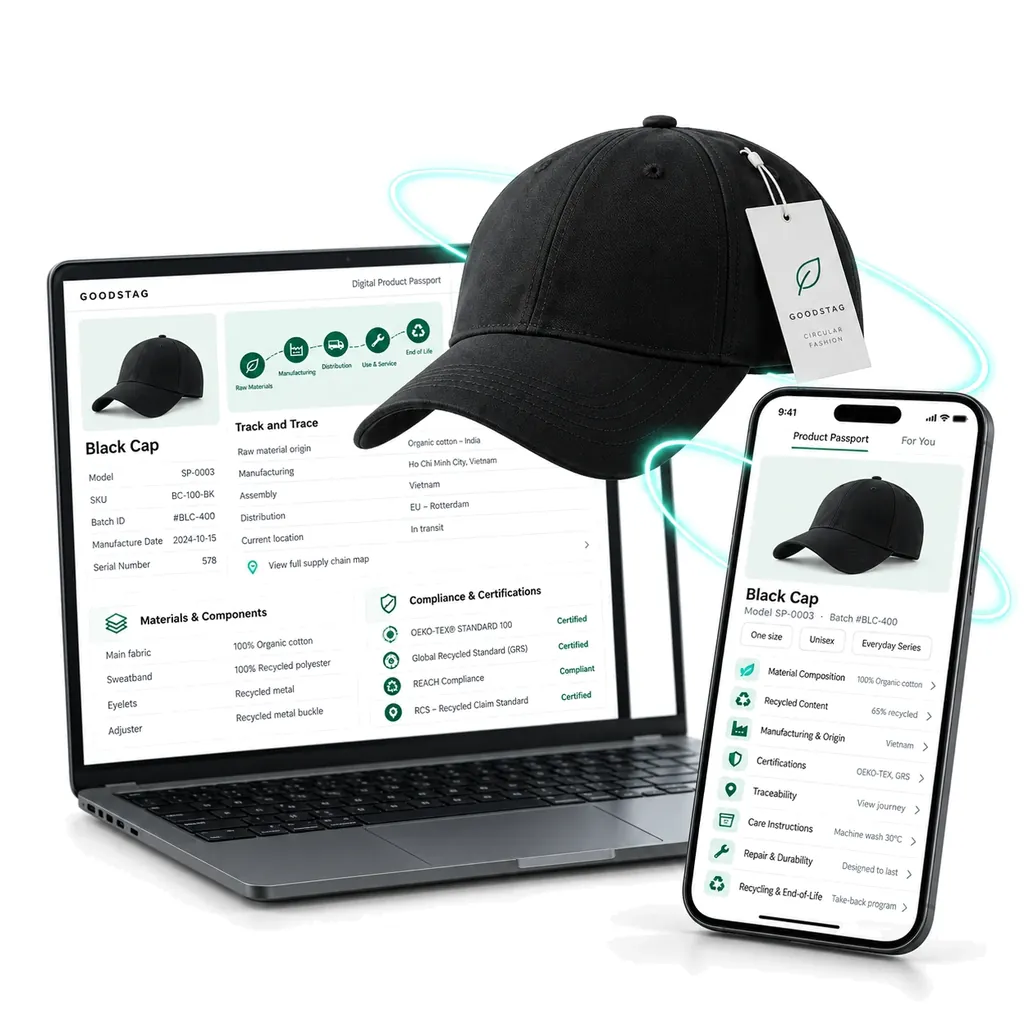
Fashion moves fast. EU regulation doesn't. The Digital Product Passport for apparel is the EU's way of making garments traceable and transparent, and easier to repair, resell and recycle. The legal framework, the Ecodesign for Sustainable Products Regulation (ESPR), is already in force. The passport becomes mandatory for apparel once the textile delegated act applies, and then it covers every brand placing apparel on the EU market.
The textile delegated act will define the exact data set. Based on the content the European Commission expects and on the PEFCR for Apparel and Footwear, a fashion passport may draw on:
Identity
Product ID (GTIN/UID), production date, reference size, net weight, responsible economic operators
Material Composition
Fibre composition, bill of materials, recycled content %, assembly loss rate, microplastic release potential
Environmental Footprint
Manufacturing energy mix, processing loss rates, 16 PEF impact categories (full lifecycle impact calculation)
Circularity, Durability & End-of-Life
Product type categorisation, durability test results (e.g. tear strength, colour fastness), repair, reuse and recycling information
Supply Chain and Traceability
Origin information, raw material mass transported, air cargo share/distances, manufacturing technologies
All structured, machine-readable, and ready for regulators, recyclers, and the next brand in the resale chain.

The regulation is evolving. We've done the reading so you don't have to.
End-to-end support to simplify your DPP rollout.
From siloed data to unclear ownership, DPP rollout is harder than it looks.
Data spread across multiple systems
Supplier information gaps
Inconsistent certifications, formats and documentation
Seasonal cycles change
Unclear internal ownership

Your DPP stays accurate through supplier changes, new seasons, and evolving regulations.

Seamlessly handles thousands of SKUs, suppliers, and complex structures.

Your data model follows the EU requirements as they are finalised, and your data stays structured for audit-ready reporting.

Proven track record in high-stakes, high-volume environments.
Implementation workflow
Collect your data, validate it, link a label, publish the passport and keep it up to date.
Step 1
Bring in ERP, PLM, PIM, quality and lab data through existing APIs, files and supplier forms.
Step 2
Map fields to versioned product-family schemas. Show validation, review, approval and how missing evidence is handled.
Step 3
Factory and logistics workflows associate a pre-printed identifier with a product, batch or item through a scan or system integration.
Step 4
Show which information is public and which evidence requires authorised access.
Step 5
Explain updates, version history, export and independent backup using the verified product and commercial terms.
Data carriers and standards, GS1 Digital Link conformant, API-first, multiple identity levels from model to item, and role-based data access.
Architecture aligned with the passport lifecycle, controlled access and GDPR-compliant processing. Successful EU Registry TEST registrations; production automated API integration in preparation.
See the live version
Your customers won't read a complex document. They'll scan a QR code or tap a NFC tag.

Here's what they (and regulators) see on the other side.
On the go? [Click here to open the demo]
Under the EU's Ecodesign for Sustainable Products Regulation (ESPR), Digital Product Passports for apparel are on their way. The final date isn't set yet, but the preparation window is shorter than most brands realise.
Here are the key dates you need to know about:






Map materials and supplier evidence across tiers, then define the regulatory passport view and consumer content. The live demo surfaces Product Passport and For You experiences without implying an unverified conformity mark regime.
Review classification, obligations, identifiers, labelling, required data, access rights and evidence. Record open interpretation questions; GoodsTag can coordinate external legal review when scoped separately.
Outputs: requirements matrix, evidence checklist and prioritised gap assessment.
Map how products are identified, labelled and released. Align ERP, MES and quality data to passport fields, and define pairing, activation and exception handling.
Outputs: process map, integration plan and pilot workflow.
Define tier requests, ownership, acceptable evidence, authenticated declarations, escalation and change management.
Outputs: automated supplier collection process via form or import, responsibilities and approval workflow.
Tell us about your fashion and textiles DPP requirements. We will help you identify the right approach.
Your message has been submitted.
We will get back to you within 24-48 hours.
A Digital Product Passport is a structured, machine-readable data set that stores verified product information across a garment's entire lifecycle. It provides end-to-end traceability for materials, manufacturing processes, environmental impact, and end-of-life handling. For the fashion industry, it is how brands will meet the passport requirements of the EU Ecodesign for Sustainable Products Regulation (ESPR): the regulation is already in force, and the textile delegated act will set the exact data and the date from which the passport is mandatory.
GoodsTag uses serialization technology to assign a unique digital identity to each individual item or batch. This identity is connected to the physical garment via QR codes, NFC tags, DataMatrix or RFID labels. When scanned, this identifier acts as an anchor and routes the user to the garment's Product Digital Twin - a live digital replica that hosts the verified DPP dataset.
By aggregating data from various sources, the platform provides a complete view of the product's journey. You can track and manage material composition, sourcing, manufacturing processes, supplier information, and logistics. Furthermore, it captures environmental impact, carbon footprint, material recovery rates, and post-sale events like returns, repairs, reuse cycles, and recycling activities.
The textile delegated act under the EU ESPR has not been adopted yet, so no platform can claim full compliance with it today. GoodsTag builds on the principles the ESPR already sets for passports: a unique product identifier, a data carrier on the product, open and interoperable formats, and access rights for consumers, recyclers and authorities. The platform is based on GS1 Digital Link. Its data models are configurable, so the textile data set can be mapped as soon as the delegated act defines it. All compliance data can be cryptographically signed, securely shared with regulators, and structured for audit-ready reporting.
Consumers can simply scan the garment's QR code or NFC tag with their smartphone to access a mobile-first, personalized experience. The platform uses a Context Engine to ensure they see relevant information based on real-time conditions. They can view sustainability claims, material transparency, repair instructions, recycling guidelines, or targeted promotions and loyalty rewards. The platform supports role-based resolution, meaning a consumer sees an engaging brand experience while a recycler sees specific compliance data.
GoodsTag features an API-first architecture that seamlessly integrates with your existing enterprise systems, including ERP, PLM, MES, PIM, and supplier databases such as SAP4Hana. Data synchronization is event-driven and supports global GS1 standards like EPCIS 2.0 and GS1 Digital Link for real-time traceability.
Absolutely. The GoodsTag infrastructure is cloud-native and built on a microservices architecture designed to support horizontal scaling. It is built for high-volume serialization and global scanning volumes, allowing brands to manage millions - or even billions - of product instances globally without compromising speed. It also adapts automatically to multi-country language and market requirements.
The platform turns the DPP into a powerful commercial asset by building high-quality, privacy-compliant zero- and first-party consumer data directly from product interactions, without third-party cookies. It unlocks post-sale engagement like targeted promotions and loyalty rewards. Additionally, the platform provides advanced analytics on consumer engagement, supply chain efficiency, and circularity metrics to optimize operational ROI.
You don't need to do everything at once. GoodsTag features a modular design that empowers brands to start at any point. You can begin digital twin implementation at the product or batch level and progressively expand to full item-level serialization as operational readiness grows. Using API-first architecture and data mapping templates, the platform facilitates rapid deployment with existing PLM or ERP systems.
The platform is identity- and label-agnostic. You can seamlessly connect physical garments using QR codes, NFC tags, RFID labels (including UHF, HF, and Dual Frequency tags), or DataMatrix codes. It natively supports the GS1 Digital Link standard. You can introduce one ID medium first (like a printed QR code) and easily add further technologies like RFID or NFC later without recreating the digital twin.
Yes. The platform supports full white-label management and redirect domains, enabling branded QR code URLs. If you use automatically generated mobile landing pages, you can fully customize the branding for each product through the branding service (brand name, logo, T&Cs, contact details, social links). This ensures users are immersed in your brand's look and feel while accessing compliant data.

Build your brand on top of compliance.
The DPP makes product transparency mandatory. Use that transparency to tell your story. The brands that get there first will use it to do something more: tell a better story, earn more trust, and turn supply chain data into a competitive edge.
Assess the entire journey: supplier data, ERP/MES integration, QR labelling, factory activation, publication and lifecycle operation.
Contact details are requested before personalised results are shown.
Select multiple product families. Battery portfolios spanning full passports and QR-only requirements receive separate ratings.
Identify missing supplier evidence, IT integration, QR production pairing, registry and lifecycle risks.
Sector checklist with tasks, owners, expected evidence and CSV/PDF export.
The complete sector-level baseline checklist. This resource is generic and available without an assessment. Complete the questionnaire for product-specific priority actions and scores.
Self-reported responses; not a certification or legal compliance verdict. Factory go-live remains subject to actual production acceptance tests.
Textile delegated act planned for 2027 · compliance date not yet set
Suggested owners and evidence are planning aids. Applicable laws and deadlines require confirmation for the product category, operator role and current regulatory version.
GoodsTag can independently review supplier data workflows, identifiers, integration and production activation, including passports built using another platform.