
01
Scope your actual products
Select multiple product families. Battery portfolios spanning full passports and QR-only requirements receive separate ratings.

Free readiness score + industry-specific implementation playbook
Why act now?
The new Construction Products Regulation applies since 8 January 2026 and makes the Digital Product Passport part of every construction product’s compliance, once its delegated act is adopted. From 1 January 2028, new buildings over 1,000 m² must disclose their life-cycle global warming potential, and designers will need product data to calculate it.
until new buildings over 1,000 m² must disclose their life-cycle carbon
1 January 2028
Life-cycle carbon disclosed for large new buildings
The construction passport comes from the new Construction Products Regulation (EU) 2024/3110, not from an ESPR delegated act. It is based on the ESPR passport, uses the same EU registry unless its delegated act sets other rules, and must stay interoperable with building information modelling (BIM). The Commission will set it up by delegated act; manufacturers must provide it 18 months after that act enters into force.
The regulation already lists what the passport contains:
Declaration of Performance and Conformity
The DoPC with the product’s essential characteristics, its unique product-type identifier and the REACH information that comes with it
Environmental Performance
Life-cycle indicators declared in the DoPC, starting with global warming potential, phased in product family by product family
Instructions and Safety
Instructions for use, installation and maintenance, safety information and the product label
Linked Material Passports
Links to the passports of the materials and key parts in each product, so their data flows into the product passport
Technical Documentation
The technical documentation, documents required by other EU law, and the data carriers of key parts for dismantling and reuse
All structured, machine-readable, and ready for architects, builders, building owners, recyclers and authorities.
DPP and DMP
A window, a brick or an insulation board is a product with its own declaration, and at the same time a set of materials that will one day be dismantled, reused or recycled. That is why GoodsTag covers both kinds of passport, linked in a parent-child relation.
Digital Product Passport (DPP)
The passport of a construction product placed on the market, such as a roof window or a pallet of bricks. The Construction Products Regulation sets its content and its delegated act will set the details.
Digital Material Passport (DMP)
The passport of a material or component, such as timber, glass or aluminium: composition, origin, recycled content, footprint and certificates. An industry and research term, not defined in EU law.
Roof window, 78 × 118 cm
Model RW-780118 · sample data
Pine wood frame
Origin, certificates, carbon footprint
Low-E double glazing
Composition, thermal data, recycled content
Aluminium cladding
Alloy, recycled content, end-of-life route
One parent, many children
Each DPP references the DMPs of the materials and key parts it contains, through persistent identifiers.
Update once, inherit everywhere
When a supplier updates a material passport, every product passport linked to it sees the change.
Each party shares what it should
Trade secrets stay protected: access rights decide which data reaches builders, building owners, recyclers or authorities.
There is no EU legal definition of a Digital Material Passport. For buildings, EU law uses the digital building logbook and the renovation passport (Directive (EU) 2024/1275). GoodsTag uses the term for material data structured like a DPP, so it can be linked to product passports.
The construction passport comes with a new regulation, a new way of declaring performance and new building carbon rules. We follow every step so you don’t have to.
End-to-end support to simplify your DPP and DMP rollout.
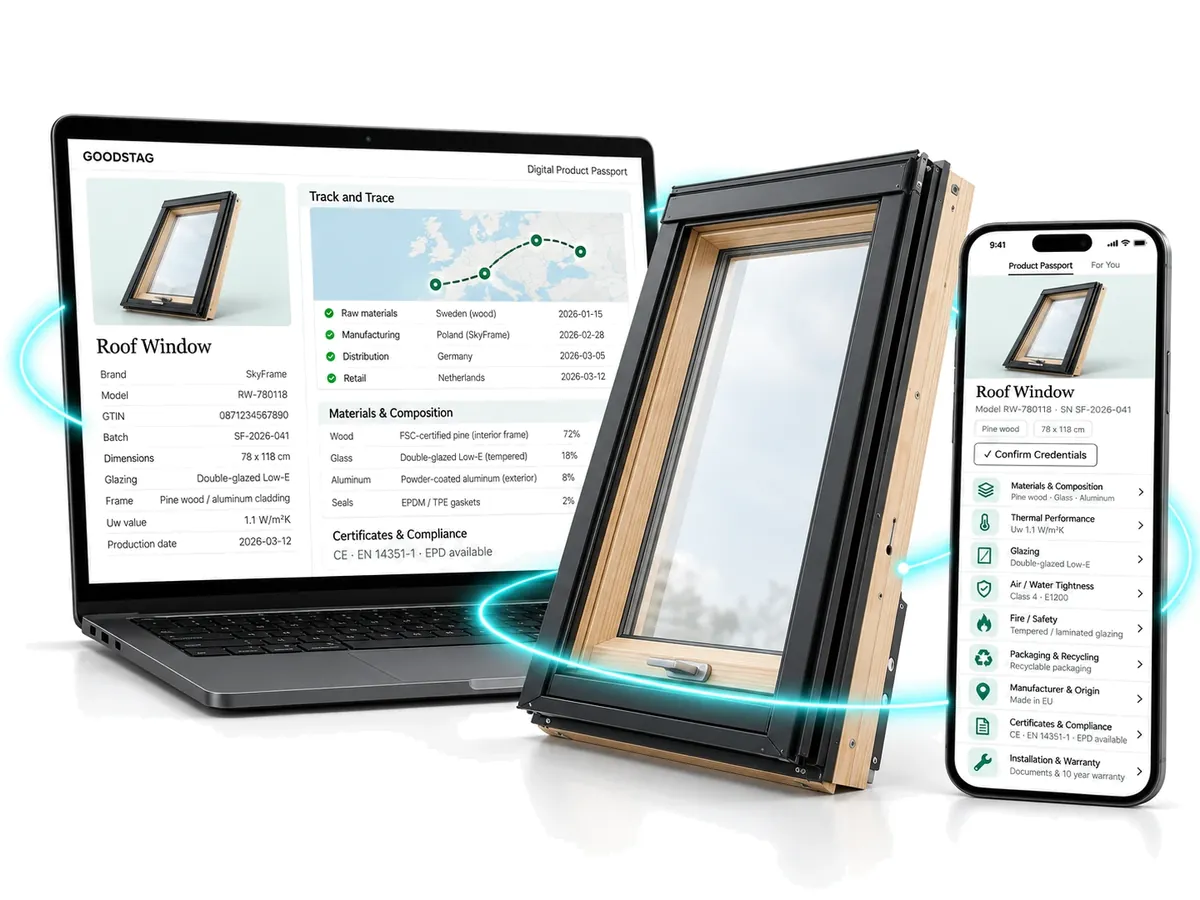
A construction passport depends on data from suppliers, plants, laboratories and certification bodies, product type by product type.
Material and component data spread across suppliers and plants
Declarations of performance, EPDs and test reports in separate systems
Life-cycle carbon data that is hard to calculate and keep current
Long product lifetimes: data must stay available for decades
Unclear internal ownership

Your passports stay accurate through new product types, updated declarations and evolving regulations, for the long life of a building.

Handles large catalogues of product types, plants and batches, with product and material passports linked to each other.

Your data model follows the CPR passport as its delegated act takes shape, from the DoPC to life-cycle indicators.

Proven track record in high-stakes, high-volume environments.
Implementation workflow
Collect your data, validate it, link a label, publish the passport and keep it up to date.
Step 1
Bring in ERP, PLM, PIM, quality and lab data through existing APIs, files and supplier forms.
Step 2
Map fields to versioned product-family schemas. Show validation, review, approval and how missing evidence is handled.
Step 3
Factory and logistics workflows associate a pre-printed identifier with a product, batch or item through a scan or system integration.
Step 4
Show which information is public and which evidence requires authorised access.
Step 5
Explain updates, version history, export and independent backup using the verified product and commercial terms.
Data carriers and standards, GS1 Digital Link conformant, API-first, multiple identity levels from model to item, and role-based data access.
Architecture aligned with the passport lifecycle, controlled access and GDPR-compliant processing. Successful EU Registry TEST registrations; production automated API integration in preparation.
Request a live demo
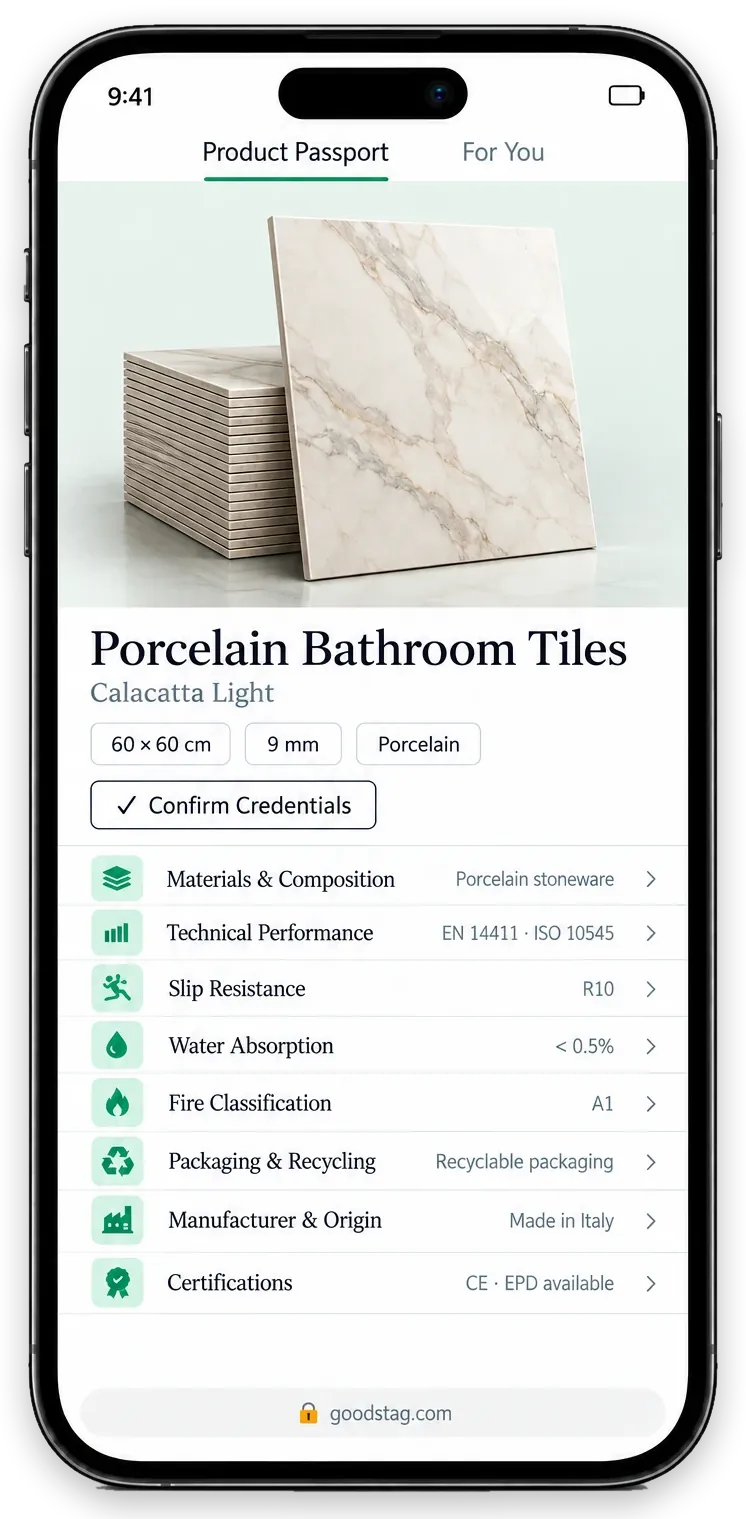
Builders won’t dig through a technical file. They’ll scan a QR code on the product, the pallet or the label.
Here’s an example of what they (and building owners and authorities) could see on the other side. Sample data only.
Want to see it with your own products? [Talk to us]
The construction passport is set out in the new Construction Products Regulation; the date it becomes mandatory depends on its delegated act, which has not been adopted yet.
Here are the key dates you need to know about (as of October 2026):






Tell us about your construction products DPP requirements. We will help you identify the right approach.
Your message has been submitted.
We will get back to you within 24-48 hours.
A Digital Product Passport is a structured, machine-readable data set that stores verified product information across a product's lifecycle. For construction products, the new Construction Products Regulation (EU) 2024/3110 sets out what it contains: the Declaration of Performance and Conformity, instructions for use and safety information, the technical documentation, the label and the unique identifiers, reachable through a data carrier on the product.
Not yet. The CPR applies since 8 January 2026, but the passport becomes mandatory only through a delegated act. As of October 2026 it has not been adopted; the European Commission lists it indicatively for Q2 2027. Manufacturers must provide passports 18 months after that act enters into force, and may use them voluntarily before.
Construction products covered by the CPR, as their product families move to the new regulation. The CPR working plan 2026–2029 starts with cement (indicatively Q4 2027) and prepares windows and doors, thermal insulation, flat glass and reinforcing steel. The working plan states that every product under the new CPR will have a passport once it is made mandatory by delegated act.
It becomes the Declaration of Performance and Conformity (DoPC), supplied electronically or on a website, and it is part of the passport. Once the passport applies, providing it fulfils the information duties for these documents. The DoPC and instructions must still be given on paper, free of charge, if the end user asks for them at the time of purchase.
The CPR adds life-cycle environmental indicators to the DoPC in phases, starting with global warming potential and extending in 2030 and 2032, as each product family gets its harmonised technical specification under the new CPR. Separately, the Energy Performance of Buildings Directive requires new buildings to disclose their life-cycle global warming potential from 2028 (over 1,000 m²) and 2030 (all), which needs product data.
A Digital Material Passport is the passport of a material or component, such as timber, glass, steel or aggregates: its composition, origin, recycled content, carbon footprint and certificates. The term comes from building circularity research; it has no definition in EU law, which uses the digital building logbook and the renovation passport for buildings. GoodsTag structures DMPs like DPPs, so the two can be linked.
In a parent-child relation. The product's DPP is the parent, and the DMPs of the materials and key parts it contains are its children, linked through persistent identifiers. Material data flows up into the product passport, and a change to a material passport reaches every product linked to it.
Much longer than for most products. The CPR foresees that construction passports stay accessible for 25 years after the last product of a type is placed on the market, with the economic operator keeping them available for at least 10 years, and requires a back-up through DPP service providers. GoodsTag stores passports so they stay available over that horizon.
GoodsTag features an API-first architecture that integrates with your existing enterprise systems, including ERP, PLM, PIM, EPD tools and supplier databases such as SAP S/4HANA. Data synchronization is event-driven and supports global GS1 standards like EPCIS 2.0 and GS1 Digital Link for real-time traceability.
The construction passport's delegated act has not been adopted, so no platform can claim full compliance with it today. GoodsTag builds on the principles the CPR already sets: a data carrier on the product linked to its unique identifier, open and machine-readable formats without vendor lock-in, free access, protection of trade secrets and a back-up copy. Its data models are configurable, so the passport can be mapped as soon as the delegated act defines it.

Build your brand on top of compliance.
The passport will make the performance, carbon and materials of every construction product visible to the people who design, build and renovate. The manufacturers that get there first will become the easy choice for low-carbon projects, and turn product data into a competitive edge.
Assess the entire journey: supplier data, ERP/MES integration, QR labelling, factory activation, publication and lifecycle operation.
Contact details are requested before personalised results are shown.
Select multiple product families. Battery portfolios spanning full passports and QR-only requirements receive separate ratings.
Identify missing supplier evidence, IT integration, QR production pairing, registry and lifecycle risks.
Sector checklist with tasks, owners, expected evidence and CSV/PDF export.
The complete sector-level baseline checklist. This resource is generic and available without an assessment. Complete the questionnaire for product-specific priority actions and scores.
Self-reported responses; not a certification or legal compliance verdict. Factory go-live remains subject to actual production acceptance tests.
CPR DPP system acts pending; product-family rules apply in stages
Suggested owners and evidence are planning aids. Applicable laws and deadlines require confirmation for the product category, operator role and current regulatory version.
GoodsTag can independently review supplier data workflows, identifiers, integration and production activation, including passports built using another platform.